
Key Takeaways
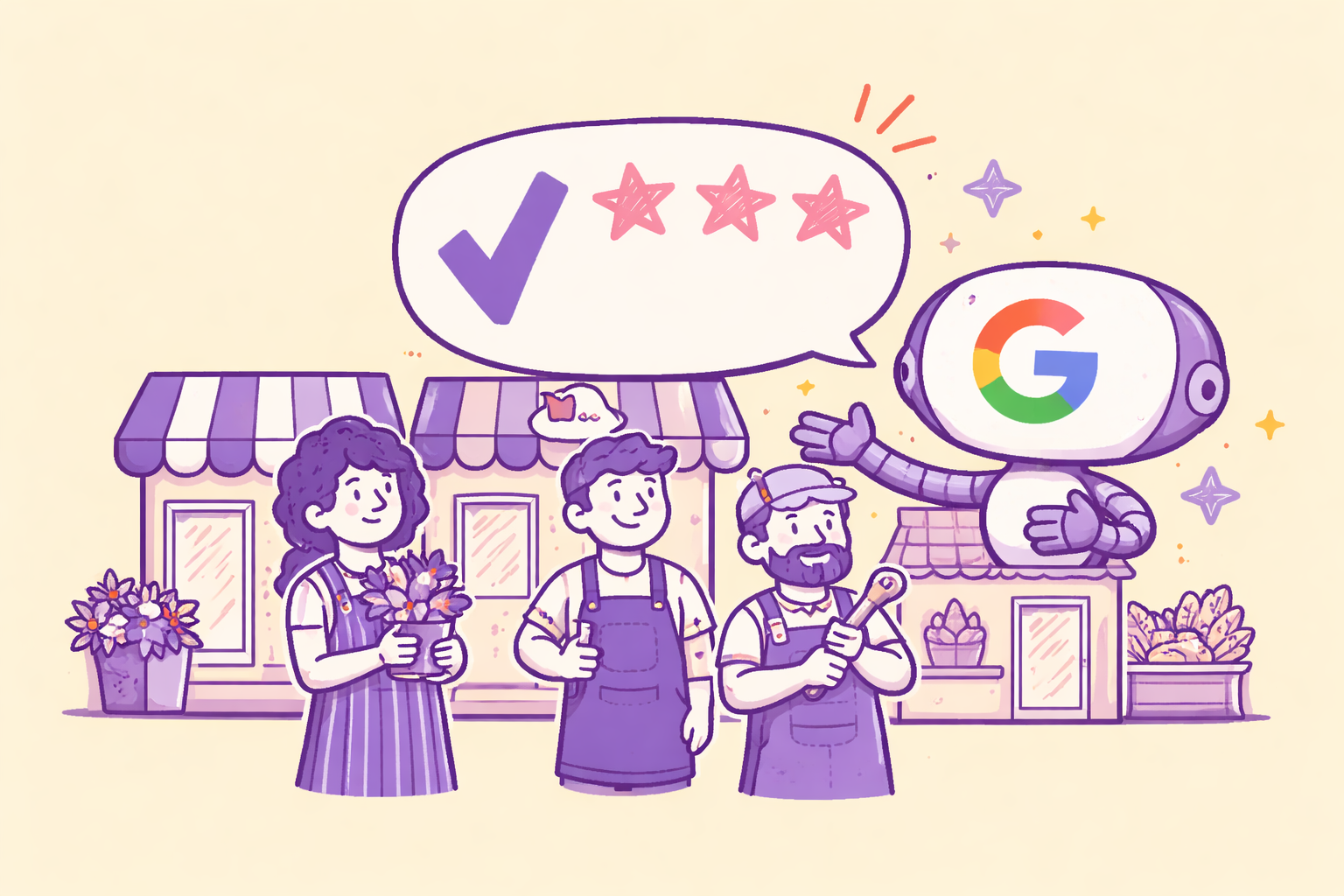
- Google AI Overviews are changing local search: AI-generated answers now appear at the top of search results, recommending specific local businesses before traditional listings
- Different signals matter for AI recommendations: Google AI prioritizes clear business information, consistent NAP data, and strong review sentiment over traditional ranking factors
- Early movers have a massive advantage: Most local businesses haven't optimized for AI visibility yet—those who start now will dominate their local markets
- Your online presence needs to be AI-readable: Structured data, clear service descriptions, and consistent information across platforms help AI understand and recommend your business
Something fundamental has changed in how people find local businesses. When someone searches "best plumber near me" or "who should I call for HVAC repair," Google doesn't just show a list of blue links anymore. It generates an AI-powered answer at the top of the page—and that answer often recommends specific businesses by name.
This is Google AI Overviews, and it's reshaping local search. According to BrightEdge research, AI Overviews now appear in roughly 47% of searches. For local service queries, that number is even higher. The businesses that appear in these AI-generated recommendations get clicked first. Everyone else fights for scraps below.
Here's the thing: most local businesses have no idea this is happening. They're still focused on the same SEO tactics from 2015. Meanwhile, their competitors are quietly positioning themselves to be the businesses Google AI actually recommends. If you run a local business—especially in home services—you need to understand how this works and what to do about it.
What Are Google AI Overviews?
Google AI Overviews are AI-generated summaries that appear at the top of search results. Instead of showing you ten blue links and letting you figure it out, Google's AI reads through available information and provides a direct answer to your question.
For local searches, this often means Google AI will recommend specific businesses. Ask "who's the best electrician in Austin" and you might see an AI-generated response that names three or four companies, explains why they're recommended, and even includes details about their services and reviews.
This is fundamentally different from traditional search results. With old-school Google, ranking #1 meant appearing at the top of a list. With AI Overviews, being recommended means Google's AI has actively chosen to suggest your business as the answer to someone's question. That's a much stronger endorsement—and it dramatically affects click-through rates.
The implications for local businesses are significant. If Google AI recommends your competitor when someone searches for your service, you've lost that customer before they ever saw your website. The AI made the decision for them.
How Google AI Decides Which Local Businesses to Recommend
Google hasn't published an official guide to AI Overview rankings. But based on extensive testing and observation, several factors clearly influence which businesses get recommended.
Information Consistency and Completeness
Google AI looks for businesses with clear, consistent information across the web. Your business name, address, and phone number (NAP) should be identical everywhere—your website, Google Business Profile, Yelp, industry directories, and anywhere else you appear online.
But it goes beyond NAP. AI wants to understand what you actually do. Vague service descriptions like "we handle all your plumbing needs" don't help. Specific information like "24-hour emergency drain cleaning, water heater installation, and bathroom remodeling in the greater Phoenix area" gives AI something concrete to work with.
Review Quality and Sentiment
Reviews have always mattered for local SEO. For AI recommendations, they matter even more—but not just the star rating. Google AI analyzes the actual content of your reviews. It looks for patterns in what customers say about you.
If multiple reviews mention that you're "always on time" or "great at explaining the problem," that becomes part of how AI understands your business. Negative patterns work the same way. Consistent complaints about communication or pricing will affect whether AI recommends you.
Website Structure and Clarity
Your website isn't just for human visitors anymore. AI systems crawl your site to understand your business. Clear, well-organized content helps AI accurately categorize and recommend you.
This means having dedicated pages for each service you offer. It means clear descriptions of your service area. It means answering common customer questions directly on your site. When AI can easily parse your website, you're more likely to appear in its recommendations.
Local Authority Signals
Google AI considers how established and authoritative your business appears within your local market. This includes factors like how long you've been in business, mentions in local news or publications, membership in industry associations, and backlinks from local websites.
A business that's been serving the community for 20 years with deep local roots will often get recommended over a newcomer—assuming all that history is visible online.
Traditional SEO vs AI Optimization: What's Different
| Factor | Traditional Local SEO | AI Optimization |
|---|---|---|
| Primary goal | Rank higher in search results | Get recommended in AI answers |
| Key metric | Search position (1-10) | Inclusion in AI response |
| Content focus | Keywords and backlinks | Clarity and structure |
| Review importance | Star rating matters most | Review sentiment and content analyzed |
| Competition | Fighting for 10 spots on page 1 | Fighting for 3-4 AI recommendations |
| User behavior | User scans and chooses | AI chooses for user |
| Timeline to results | Months of consistent effort | Can see impact in weeks |
The biggest shift is in how competition works. Traditional SEO meant trying to outrank nine other businesses on page one. AI optimization means trying to be one of the three or four businesses that AI actually mentions by name. The stakes are higher, but so is the payoff.
The Five Pillars of Google AI Visibility for Local Businesses
Getting recommended by Google AI isn't random. It comes down to five core areas that you can actually control and improve.
Pillar 1: Google Business Profile Optimization
Your Google Business Profile is the foundation of local AI visibility. This is often the primary source Google AI uses to understand your business.
Complete every section of your profile. Add all relevant service categories. Write a detailed business description that clearly explains what you do and where you do it. Add photos regularly. Respond to reviews—both positive and negative.
Most importantly, use the Q&A feature. Add questions that potential customers commonly ask, then provide detailed answers. This gives AI specific information to reference when generating recommendations.
Pillar 2: Structured Content That AI Can Parse
AI systems don't read websites like humans do. They parse structured data and look for clear patterns. Help them out.
Use FAQ schema markup on your website. Create dedicated pages for each service with clear headings, descriptions, and pricing information where appropriate. Make sure your contact information and service area are prominently displayed and consistent.
Consider adding a question-and-answer section to your website. Not a generic FAQ, but actual questions customers ask you—with detailed, helpful answers. This creates content that AI can directly cite when recommending businesses.
Pillar 3: Review Strategy That Builds AI Trust
You need reviews, but you need the right kind of reviews. Encourage customers to be specific about their experience. "Great service!" doesn't help AI understand your business. "They replaced our water heater the same day we called, explained all our options, and cleaned up perfectly" tells a story AI can use.
Respond thoughtfully to every review. Your responses show AI how you handle customer interactions. A business that responds professionally to complaints demonstrates reliability. A business that ignores negative reviews raises red flags.
Monitor what customers say across platforms. Google AI doesn't just look at Google reviews—it considers your reputation everywhere.
Pillar 4: Local Citation Consistency
Citations are mentions of your business on other websites—directories, industry sites, local chambers of commerce, and anywhere else your business appears. AI cross-references these citations to verify your information.
Inconsistencies create problems. If your address is slightly different on Yelp than on your website, or your phone number varies across directories, AI becomes less confident about your information. Less confidence means fewer recommendations.
Audit your citations regularly. Make sure your NAP data matches exactly everywhere. Remove or update outdated listings. Add your business to relevant industry-specific directories.
Pillar 5: Content That Demonstrates Expertise
Google AI wants to recommend businesses that actually know what they're doing. Demonstrate your expertise through content.
Write about the services you provide. Explain common problems and solutions. Share case studies or project descriptions. The goal isn't keyword stuffing—it's showing AI that you genuinely understand your trade.
A roofing company that publishes detailed content about different roofing materials, common repair issues in their climate, and what homeowners should look for in a contractor is demonstrating expertise. AI recognizes this and factors it into recommendations.
Step-by-Step: How to Audit Your Google AI Visibility
Before you can improve, you need to know where you stand. Here's how to check your current AI visibility:
-
Search for your services: Go to Google and search "[your service] in [your city]." Look for AI Overview responses. Is your business mentioned? Are your competitors?
-
Ask Google AI directly: Use conversational queries like "who should I call for [service] in [city]" or "best [service provider] near [location]." These often trigger AI recommendations.
-
Check your Google Business Profile: Is every section complete? Are your services accurately listed? When was your last review, and what did it say?
-
Audit your website: Can AI easily understand what you do and where? Is your content structured with clear headings? Do you have dedicated service pages?
-
Review your citations: Search for your business name. What comes up? Are the listings accurate and consistent?
-
Analyze your reviews: Read through your recent reviews. What patterns emerge? What do customers consistently praise or criticize?
This audit will reveal gaps in your AI visibility. Most businesses find significant room for improvement.
Common Mistakes That Hurt AI Visibility
Certain practices actively prevent Google AI from recommending your business. Avoid these mistakes:
Thin or duplicate content: If your website has minimal information or uses the same descriptions across multiple pages, AI has nothing to work with. Each service page should offer unique, detailed content.
Ignoring your Google Business Profile: A half-complete profile with outdated information tells AI your business isn't active or reliable. Keep your profile current and comprehensive.
Inconsistent information: Different addresses, phone numbers, or business names across platforms confuse AI. It can't confidently recommend a business it can't verify.
No review engagement: Businesses that never respond to reviews appear disengaged. AI considers how businesses interact with customers when making recommendations.
Keyword-stuffed content: AI is sophisticated enough to recognize when content is written for algorithms rather than humans. Natural, helpful content performs better than keyword-stuffed pages.
Missing structured data: Without schema markup, AI has to work harder to understand your website. Make it easy by implementing proper structured data.
How Long Does It Take to See Results?
Unlike traditional SEO, which can take months to show improvement, AI visibility changes can produce faster results. Google AI constantly re-evaluates information and updates its recommendations.
Some businesses see changes within weeks of making significant improvements to their Google Business Profile or website structure. Others take longer, especially if they're competing in crowded markets or starting with significant visibility gaps.
The key is consistency. Make improvements, monitor results, and keep refining. AI visibility isn't a one-time fix—it's an ongoing process of ensuring your business information is clear, accurate, and comprehensive.
What About Other AI Platforms?
Google AI Overviews get the most attention because they appear directly in Google search. But other AI platforms also recommend local businesses.
ChatGPT, Perplexity, and similar AI assistants handle millions of queries about local services. When someone asks ChatGPT "who's a good plumber in Denver," it generates recommendations based on information it can find online.
The good news: the same factors that improve Google AI visibility also help with other AI platforms. Clear, consistent information across the web makes your business more likely to be recommended everywhere AI is making suggestions.
Pantora tracks how your business appears across all major AI platforms—Google AI Overviews, ChatGPT, Perplexity, and others. You can see exactly which queries mention your business, how AI describes you, and how you compare to competitors. Pantora also creates an AI-optimized website for your business and provides weekly recommendations to improve your visibility. It's the comprehensive solution for businesses serious about AI visibility.
The Competitive Advantage of Moving Now
Here's why this matters so much right now: most local businesses haven't figured this out yet. They're still doing the same things they've always done—maybe posting to social media, maybe running Google Ads, maybe working on traditional SEO.
AI visibility is wide open. The businesses that start optimizing now will build an advantage that's hard for competitors to overcome later. It's like reviews were 10 years ago. The contractors who aggressively collected Google reviews early now have 500+ reviews. Their competitors who started late are still stuck at 50.
First movers in AI visibility will become the default recommendations in their markets. Once AI learns to recommend your business consistently, it takes significant effort for competitors to displace you.
This window won't stay open forever. As more businesses catch on, the competition will intensify. The time to act is now.
Building Your AI Visibility Strategy
Based on everything above, here's a practical approach to improving your Google AI visibility:
Week 1: Audit and foundation
- Complete the visibility audit described above
- Fix any critical issues with your Google Business Profile
- Identify inconsistent citations and start correcting them
Week 2-4: Content and structure
- Add or improve dedicated service pages on your website
- Implement FAQ schema markup
- Create Q&A content that answers common customer questions
Month 2: Reviews and reputation
- Implement a system for requesting specific, detailed reviews
- Respond to all existing reviews you haven't addressed
- Monitor review platforms for new feedback
Ongoing: Monitor and improve
- Regularly search for your services to see if AI mentions you
- Track competitor visibility and identify what they're doing well
- Continue adding helpful content and maintaining accurate information
What Comes Next for AI and Local Search
AI-powered search is only going to become more prevalent. Google continues expanding AI Overviews. ChatGPT and other AI assistants are becoming mainstream tools for finding local services. Voice assistants increasingly use AI to generate recommendations.
The businesses that build strong AI visibility now are positioning themselves for this future. They're not just optimizing for today's algorithms—they're building a presence that AI systems will recognize and recommend for years to come.
This isn't about gaming any system. It's about making sure AI accurately understands your business and recognizes the quality of your work. You're already doing great work for your customers. AI visibility is about making sure AI knows it too.